









Peppol is neither software nor a platform: it's the network that allows two companies to exchange invoices without knowing each other beforehand. Since September 1, 2026, it has played a central role in the French reform.
Peppol in a nutshell
Peppol is a business document exchange network based on a simple principle: a company connects once, to a single provider, and becomes reachable by all other companies connected to the network, wherever they are located. The name is an acronym for Pan-European Public Procurement On-Line, inherited from a European project originally dedicated to public procurement, but its use has far exceeded this initial scope.
The most accurate comparison is email. You haven't signed an agreement with your client's email provider to send them a message. You have an address, they have one, and the infrastructure takes care of the rest. Peppol does the same thing for invoices, purchase orders, and shipping notices, with one major difference: the document content is standardized, so the receiving machine can read it without human intervention.
This standardization is what gives the network its value. A Peppol invoice isn't an image or a PDF that someone has to re-enter. It's a structured file where each piece of information has a defined place: the invoice number here, the amount excluding tax there, and the VAT rate in that precise location. The recipient's software integrates it directly into their accounting system.
What Peppol is not
Three common misconceptions keep recurring, and they cost companies time as they try to understand what is expected of them. It's best to clear them up right away.
Peppol is not a software program that you install. You don't download Peppol, you don't create a Peppol account. You use a service provider who is connected to the network. For you, the experience is similar to your usual invoicing tool: you create an invoice, you click send, and the service provider takes care of sending it.
Peppol is not a central platform. There is no single server through which all of Europe's bills pass. The network is decentralized: dozens of providers each operate their own access points, and these access points communicate with each other according to common rules. No one owns the network; everyone follows its rules.
Peppol is not just another invoice format. This is a common misconception, as it's often confused with Factur-X or UBL. Peppol defines a content format, a method for identifying participants, and a transport protocol. The format is only one of these three components, and discussing Peppol solely in terms of format is like confusing an envelope with the postal service.
The four-cornered model, explained without jargon
All the technical literature on Peppol refers to the "four-cornered model". Behind this somewhat abstract name lies an idea that can be understood in thirty seconds.
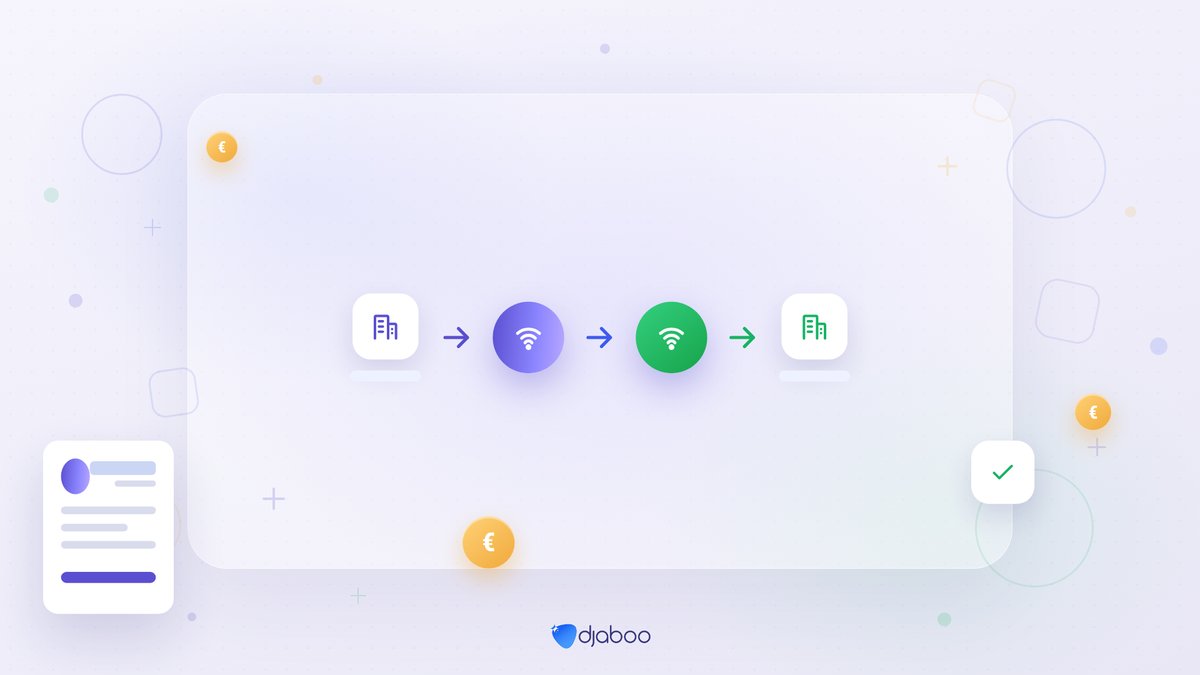
Imagine four positions. At the first corner, the company issuing the invoice. At the second, its service provider, the one operating a network access point. At the third, the recipient's service provider. At the fourth, the recipient company itself. The invoice starts at the first corner, goes up to the second, travels across the network to the third, and then back down to the fourth.
The advantage of this breakdown is that it eliminates the combinatorial problem. Without a network, if a thousand companies want to exchange electronic invoices, they would potentially need to establish hundreds of thousands of bilateral connections. With the four-corner model, each company establishes only one connection, the one linking it to its service provider. The rest is shared.
This architecture also explains why you don't have to worry about your client's software choice. Whether they work with a French, German, or Dutch software publisher is irrelevant, as long as they are connected to the network. This is precisely the meaning of the word interoperability, which is constantly mentioned in official documents.
The three technical building blocks
A Peppol connection is based on three distinct elements. Distinguishing them helps to understand the questions you will be asked.
The participant's ID
For an invoice to reach its destination, it needs an address. On Peppol, this address is an identifier constructed from an existing company number, preceded by a code that specifies the type of number. In France, the SIRET number and the intra-community VAT number naturally serve as the basis.
This identifier is published in a distributed directory. In practice, when your service provider wants to send an invoice, it first queries this directory to determine if the recipient is reachable, via which access point, and for what types of documents. This step is invisible to you, but it's what allows the network to function without a single central directory.
The document format
Peppol relies on a specification called Peppol BIS, itself built on the European standard for electronic invoicing and on the UBL syntax. This technical vocabulary covers a simple reality: a set of rules that specify what information must appear in an invoice, in what format, and which information is mandatory.
These rules are not mere recommendations. A document that does not comply with them is rejected by the network before it even reaches its recipient. This is a strict requirement, and it is precisely what ensures that a received invoice can be processed automatically.
Transportation
The third component is the protocol that actually routes the file from one access point to the other. It ensures the encryption of the exchanges, the authentication of both access points, and, most importantly, the acknowledgment of receipt: the sender knows whether their document has arrived. This last feature has considerable legal and operational value, since it puts an end to disputes about invoices that were supposedly never received.
Each access point must have certificates issued within a public key infrastructure. This prevents just anyone from connecting to the network and injecting documents into it.
How an invoice travels, step by step
Let's review the complete journey of an invoice, from the sender's click to its integration with the recipient.
Step 1. You create the invoice in your management tool, just as you do today. Nothing changes in your daily routine.
Step 2. Your tool transmits the invoice to your service provider, who converts it to the format expected by the network if it is not already, and who checks that it complies with the validation rules.
Step 3. The service provider queries the directory to find the recipient's access point using their identifier.
Step 4. The document is transmitted from access point to access point, in encrypted form, with a technical acknowledgment in return.
Step 5. The recipient's service provider makes the invoice available to them, either in their accounting software or in their portal.
Step 6. The recipient integrates the invoice, matches it to their order if necessary, and triggers their validation process.
The whole process takes a few seconds. The difference with sending by email is not the speed, but the fact that no one needs to re-enter anything, and that a record of the exchange exists on both sides.
Why is France connecting to it?
The French reform of electronic invoicing requires approved platforms to be interoperable. The legal framework provides two ways to achieve this: signing a bilateral interoperability agreement with another approved platform, or using a network information exchange protocol.
The first option runs up against the combinatorial problem described above. With several dozen approved platforms, the proliferation of bilateral agreements quickly becomes unmanageable, and each new platform would have to negotiate with all the others. The second option, the network exchange protocol, solves the difficulty at once: everyone applies the same rules, and interoperability results from their compliance.
Peppol already existed, it was tried and tested, used in several European countries, and designed precisely for this need. The choice was obvious.
The DGFiP has become the Peppol Authority for France
This is a point that is rarely mentioned, yet it changes the nature of the subject.
Peppol is developed by OpenPeppol, an association that delegates some of its responsibilities to national authorities. These authorities approve service providers who then become certified access point providers within their territory. The French Public Finances Directorate (DGFiP) has assumed this role for France.
In other words, the French tax authorities are not simply users of the network: they are one of its guardians within the national territory. They are the ones who sign agreements with French service providers, who can define additional requirements, and who decide on the conditions of access within their jurisdiction.
National requirements, or why Peppol is not enough
A national Peppol authority can impose technical rules specific to its territory, known as Peppol authority-specific requirements. This power is not merely theoretical, and France has made use of it.
The most fundamental requirement is this: to be authorized to issue and receive electronic invoices under the French reform, one must be registered as an approved platform. Simply being connected to Peppol is therefore insufficient.
This distinction is important to understand because it is the source of many business misunderstandings. A publisher can perfectly well be a Peppol service provider without being an approved platform, and vice versa. The two statuses correspond to two different logics: one is technical and European, the other is regulatory and French. To operate effectively within the reform framework, both are necessary.
When a provider tells you they are "Peppol-compatible," the real question isn't whether they're telling the truth. It's whether this compatibility comes with the status of an approved platform, or whether it simply describes a connection to a platform that already holds that status. Both answers are acceptable, but they entail different obligations.
The timetable for French reform
The reform is being rolled out in two stages, depending on the size of the company. The following dates are mandatory and will not change with the current year.
Since September 1, 2026All businesses, regardless of size, must be able to receive invoices electronically as soon as their supplier is required to issue them in this format. From the same date, large and medium-sized businesses are required to issue invoices electronically and to transmit their transaction information and payment data to the authorities.
Effective September 1, 2027The obligation to issue and transmit electronically to the administration extends to small and medium-sized enterprises as well as micro-enterprises.
Two practical consequences arise from this sequence. The first is that the obligation to receive invoices already applies to everyone: a three-person company that still invoices in PDF format must nevertheless be able to receive an electronic invoice from a large client. The second is that the 2027 deadline does not exempt anyone from anything today, since a supplier subject to the obligation to issue invoices since 2026 will send its invoices in this format, whether its client is ready or not.
What does this change for a company that is not a software publisher?
The vast majority of businesses have no reason to become Peppol service providers. The relevant question for them is not "how do I connect to Peppol," but "does my billing system make me compliant, and if so, how?"
Three checks are enough to frame the subject.
Which approved platform will my invoices be processed through? This is the central question. Either your publisher is registered themselves, or they rely on a partner who is. In either case, they must be able to tell you clearly and name the entity in question.
Am I able to receive it right now? The obligation to receive electronic invoices is already in effect. If you don't know where your suppliers' electronic invoices will end up, that's the first issue to address, even before the issue of issuing them.
Is my master data clean? A participant identifier is generated from the SIRET number and the intra-community VAT number. Incomplete customer records or incorrect numbers will result in rejections, and these rejections are technical: the invoice is not sent, without anyone immediately noticing. This data validation work is not very visible, yet it is the one that prevents the most incidents.
Becoming a Peppol service provider in France
This section is for publishers and operators planning to run their own access point. The procedure published by the administration has four steps for a company headquartered in France that is not yet a service provider.
1. Become a member of the OpenPeppol network. This is the prerequisite for everything else, and it is done directly with OpenPeppol.
2. Sign the service provider agreement with the Peppol France Authority. The agreement template can be downloaded from the government's online services platform. After validation, the authority sends the signed agreement back by email.
3. Pass the compliance tests. You need to request the necessary certificates from the dedicated service to access the test environment, and then demonstrate that the services function according to specifications. Good news for project management: you don't need to have finalized the agreement to begin testing; the two projects can proceed in parallel.
4. Transition to operational status. Once the tests are successful and the agreement is signed, the application for production certificates can be submitted, attaching the agreement. Upon receipt, the service can be activated.
The case of a service provider already certified by Peppol and headquartered in France is shorter: it signs the agreement with the Peppol France Authority, which then notifies the Peppol coordinating authority, which makes the necessary changes and manages the evolution of the certificate as needed.
One point to note for international groups: if the head office is located in a third country, the agreement is signed with the Peppol authority of that country, or directly with OpenPeppol if none exists. In this case, it is not necessary to contract with the French authority.
Certificates, a poorly anticipated point
Two rules are worth remembering, because they regularly surprise project teams.
First, the Peppol France Authority is not responsible for managing certificates. These fall under a separate process, and contacting the wrong entity wastes weeks.
Next, each approved platform must have its own certificate. Sharing a certificate between several legal entities within the same group is not feasible, which has direct consequences on the chosen architecture and budget.
French service providers who have signed with the Peppol France Authority
The administration publishes the list of service providers headquartered in France who have signed the agreement with the Peppol France Authority. Here is the list as it stood on December 22, 2025. It is subject to change, so please check the current version before using it in a tender.
74Software, Accenture, Agena 3000 Data Management, Agicap, API First, Arteva, Avalara France, AVN Saint-Quentin, Axe-Innovation, Azopio, Basware, BLG Business Communication Solutions, Cecurity.com, Cegedim, Cegid, Chaintrust, Conseil Récupération VATA, Darva, Dext France, Digitica, Docoon, DocProcess France, Doxallia, Edicom Paris, Edics, EDT Electronic Data Transfert, Entropics, Esalink B2B Services, Euro-Information, Européenne de Traitement de l'Information, Expensya, Expert-Comptable Média Association, Fiducial Cloud, Fulll, Generix Group, IGA Assurances, Indy.fr, Infologic Engineering, Iopole, IPT Technologie, Klekoon, Kolecto PDP, Lucca, Macompta.fr, My Unisoft, N2JSoft, Nexcer, Open Bee France, P&F Partner & Finance OneUP, Pitney Bowes, Pytheas Capital Advisors, Qweeby PDP, Esker, @GP, Scribee, Sellsy La Rochelle, Septeo, Serensia, Seres, Siagilus, Sidetrade, Sigma Informatique, Spendesk, Super G, Symtrax, Tenor, Tessi, Tiime PDP, TX2 Concept, Ventya, Voxis Technologies Saint-Girons, Yooz PDP.
Two key takeaways emerge from this list. The first is its diversity: it includes accounting software publishers, document management specialists, expense management providers, consulting firms, and international groups. The second is that inclusion on the list reveals nothing about the functional scope of the offering. A provider may excel at document transport but offer no sales management services, or vice versa.
Peppol beyond France
The network was not designed for the French reform, and that is precisely what makes it so robust. It is used in several European countries, where it serves both for exchanges with the public sector and for exchanges between businesses, and its use has spread beyond Europe.
For an exporting company, this international dimension is a tangible advantage. A supplier connected to meet French requirements becomes reachable by foreign customers who are also connected, without any additional project. This is a welcome side effect of a regulatory constraint, and one that is rarely highlighted.
The downside is that the same network may host different national rules. A document valid in France may not be valid elsewhere if the recipient country imposes its own requirements. For cross-border transactions, verification is necessary on a case-by-case basis rather than as a general rule.
The most common mistakes
Confusing technical compatibility with regulatory status. This is the most costly mistake, and it was detailed above. Being connected to the network does not constitute registration as an approved platform.
Treat the subject like an IT project. The connection is the easy part. The difficult part is the quality of third-party data, the review of internal validation processes, and the training of those who enter invoices. A company whose customer file contains incorrect SIRET numbers will experience rejections, regardless of its system.
Wait for the date that applies to you before taking action. The reasoning is tempting for a small structure whose obligation to issue begins in 2027. It forgets that the obligation to receive already applies, and that a large corporate client will not wait.
Consider the PDF to be an electronic invoice. A PDF sent by email remains an image from the perspective of the receiving machine. The reform aims for structured, machine-readable documents. It's a difference in kind, not in degree.
Ignoring the acknowledgment of receipt. Verifying that the invoice has been sent is not enough. The network generates technical feedback, and an unmonitored flow can silently fail for weeks. Plan who checks this feedback, and how often.
Questions to ask your publisher
If you need to choose between several solutions, these six questions frame the discussion better than a list of features.
- Are you registered as an approved platform, or do you use a partner that is? If it's a partner, which one?
- Are you a Peppol service provider under the authority of Peppol France, and since when?
- How do your customers currently receive electronic invoices from their suppliers?
- What exactly happens when an invoice is rejected by the network, and how am I notified?
- How do you handle the transfer of my third-party data, and in particular the verification of SIRET numbers?
- What formats do you accept as input, and what formats do you produce as output?
The quality of the answers is just as important as their content. Someone who can spontaneously distinguish between the regulatory status of a technical connection knows their subject. Someone who answers "yes, we are Peppol compliant" to every question isn't helping you.
To be findable, the condition that is forgotten
A company can be perfectly connected and yet remain unreachable. It seems absurd, and yet it's the most common incident in the first few weeks.
The network operates on a distributed directory. When your service provider tries to contact a recipient, it asks two successive questions. The first is which access point serves that identifier. The second is what types of documents that recipient accepts. If the answer to either question is missing, the transmission fails.
In practice, three situations produce this result. The recipient has never been listed in the directory, either because their service provider hasn't done so or because the connection isn't complete. The recipient is listed, but under a different identifier than the one you use—typically a VAT number when you use a SIRET number. Or they are listed and accept invoices, but not the specific type of document you're trying to send.
The practical consequence is that you must treat publication as a separate step and verify it. Ask your service provider how they confirm that you are indeed published, and under what identifier. The day a client tells you they aren't receiving anything, you'll know where to start.
This mechanism also explains why the quality of your customer database is so important. An outdated SIRET number after a move or a change of legal structure results in an identifier that doesn't correspond to anyone. The invoice won't be sent, and the issuer won't be notified if no one is monitoring returns.
What changes in daily work
Articles about the reform describe the obligations at length and rarely the day-to-day realities. Yet that is where adoption will take place.
The data entry disappears on the receiving side. This is the most tangible benefit. A supplier invoice arrives pre-structured, seamlessly integrated into the accounting system with its line items, amounts, and rates. The re-entry work, which consumes a considerable amount of time for accounting departments in small businesses, is eliminated. The control aspect remains, however, and that doesn't disappear.
The nature of the disputes is changing. Today, some disagreements concern receipt: was the invoice sent, to which address, and when? These discussions are resolved, since the network produces a record for both parties. However, fundamental disagreements, regarding the content or the amount, remain unresolved. The network proves delivery, not agreement.
Waste becomes a flow to be managed. This is the most underestimated point. A non-compliant invoice is rejected before it even arrives, and someone needs to see the rejection, understand it, and correct it. In a small organization, this responsibility must be assigned. Otherwise, rejections accumulate silently and are only discovered during bank reconciliation, several weeks later.
Payment deadlines are becoming increasingly tight. When the invoice arrives instantly and is processed automatically, the timer starts running faster and excuses for delays disappear. This benefits the supplier, but it requires the customer to expedite their internal approval processes. The internal approval process, based on implicit postal delays, then becomes unsustainable.
Marginal billing methods stand out. The handwritten invoice, the manually altered quote, the amount adjusted afterward in a spreadsheet: all these informal practices become visible because they don't fit into a structured workflow. The reform acts as a catalyst, revealing poorly managed processes, which is uncomfortable in the short term but beneficial in the long run.
A six-week preparation plan
For a small or medium-sized business starting from scratch, here's a realistic sequence. It assumes your editor is ready, which is the first thing to check.
Week 1, the current situation. List how you currently issue invoices, through which channels, and how many still bypass your management system. Similarly, list your incoming supplier invoices. The goal isn't to be exhaustive, but to identify the flows that are currently bypassing the system.
Week 2, the publisher. Ask the six questions listed above. Obtain in writing the name of the approved platform through which your invoices will be processed, and the date on which the feature will be available in your version.
Weeks 3 and 4, the data. This is the bulk of the work. Check the SIRET numbers and intra-community VAT numbers of your active clients, starting with those who generate the most invoices. Correct, complete, and delete duplicates. This step is tedious and determines everything else.
Week 5, the circuits. Determine who approves what, within what timeframe, and who monitors rejections. Write it down, even briefly. An unassigned responsibility is an unfulfilled responsibility.
Week 6, the real test. Issue and receive real invoices with one or two willing partners, rather than relying solely on a test environment. Discrepancies always surface in real-world scenarios: a specific detail, an unusual VAT rate, or an order reference expected by the customer.
This timeline fits within a month and a half for a simple structure. It lengthens as soon as there are multiple legal entities, international flows, or a custom-developed management system. In these cases, allow for a quarter, and start with the data.
The two paths towards interoperability
It is worth revisiting the two options provided by the legal framework, because it will inform your choice of service provider.
La bilateral interoperability agreement This involves two approved platforms directly agreeing on the technical details of their data exchange. It's flexible and suitable for close relationships between two parties, but it quickly becomes cumbersome as the number of partners increases. A platform operating solely in this way would have to negotiate with each of the others to ensure its customers are reachable everywhere.
Le network exchange protocolIn France, this system, known as Peppol, replaces these negotiations with a set of common rules. A connected platform becomes accessible to all others without any additional steps. This is why this approach is becoming the foundation of the system.
For you, the consequence is direct. A platform connected to the network makes your invoices addressable to all connected businesses. A platform relying solely on bilateral agreements only makes them addressable to its signatory partners, which is a difference in coverage, not technical quality. This issue therefore deserves to be included in your selection criteria.
Where is Djaboo located?
Djaboo is a business management software: quotes, invoices, payment reminders, customer tracking. Electronic invoicing is prepared here as everywhere else, by producing compliant invoices and using an approved platform for transmission.
To find out precisely what the reform means in your case, two resources are available on this site. electronic invoicing simulator It tells you in a few questions which obligations apply to your company and by what deadline. The page dedicated to the approved platform details what this status covers and what it implies for you.
If you want to go back a step and start the subject from the beginning, the guide to electronic invoicing covers the entire reform, while the page e-reporting deals specifically with the transmission of transaction and payment data to the administration, which is the other aspect of the obligation and is discovered late.
What to remember in 2026
Peppol is a network, not a product. You don't buy it, you access it through a service provider, and that provider must also be registered as an approved platform to operate under the French reform.
The French Public Finances Directorate (DGFiP) has become the Peppol Authority for France, giving it the power to add national requirements to European rules. This is the origin of the registration requirement, and why the mere mention of "Peppol compliant" is never sufficient to qualify an offer.
The obligation to receive the certificates has applied to all companies since September 1, 2026. The obligation to issue the certificates began on the same date for large and medium-sized companies, and will be extended on September 1, 2027 to small and medium-sized enterprises as well as micro-enterprises.
Ultimately, the real challenge isn't technical. It lies in the quality of your third-party data, the review of your validation processes, and the monitoring of network feedback. A company that addresses these three areas will be ready, regardless of the tool it chooses.
F.A.Q
Is Peppol mandatory in France? No, what is mandatory is electronic invoicing and the use of an approved platform. Peppol is the network exchange protocol chosen to ensure interoperability between these platforms, making it the primary method, but the legal framework also provides for bilateral interoperability agreements.
Do I need to register myself on Peppol? No. A regular company connects through its service provider, who then lists it in the network directory. Joining OpenPeppol is for publishers and operators who want to run their own access point.
What is the difference between Peppol and Factur-X? Factur-X is an invoice format that combines a human-readable PDF with machine-readable structured data. Peppol is a network that, in addition to its format, defines a method for identifying participants and a transport protocol. The two are not mutually exclusive; they simply operate at different levels.
Can my accountant handle this? Yes, and several software publishers catering to law firms are among the signatory providers. However, ask them the same questions you would ask any publisher, particularly regarding their accredited platform status.
What happens if my client is not connected? If the recipient is subject to the obligation to receive mail, as has been the case for all businesses since September 1, 2026, then they must receive it. In practice, a recipient not found in the directory results in a rejection, and it is at this point that the matter is resolved on a client-by-client basis.
How much time should I allow? The connection itself takes days once the publisher is ready. Verifying third-party data and reviewing internal processes takes weeks, and this is the part that determines when you will actually be operational.