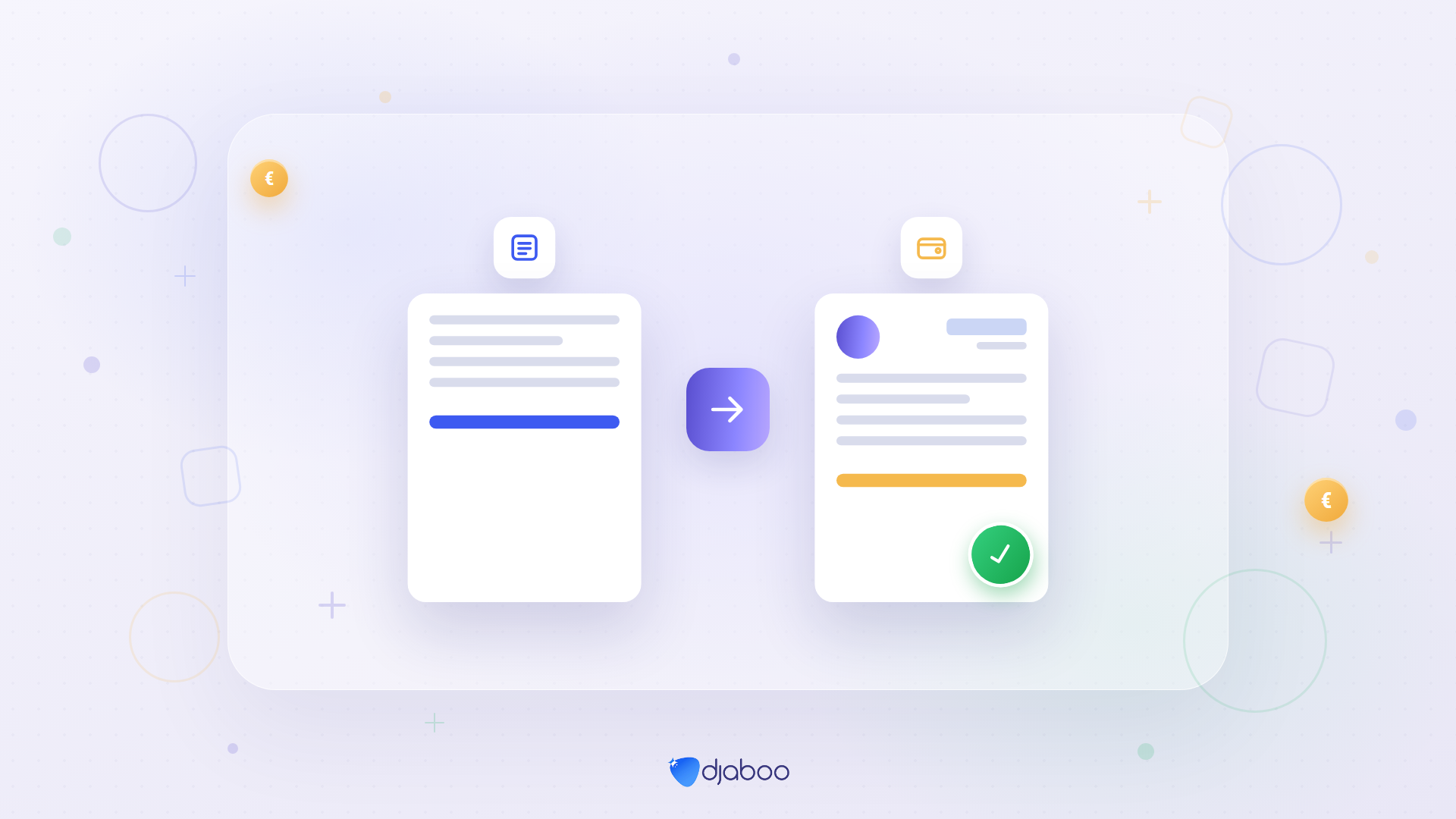
Le purchase order and invoice These are two documents that every French micro-enterprise or SME uses daily, often without fully understanding the differences between them. Yet, confusing them is costly: late payments, disputes with clients, and problems during tax audits. According to a Coface study, 85% of French companies experienced late payments in 2024, with an average delay of 13,6 days. Some of these delays are due to misused or incomplete documents. This guide explains, simply and practically, what these two documents are, how they differ, how they relate to each other, and what mistakes to absolutely avoid. Djaboo offers a dedicated module: customer order.
What is a purchase order?
The purchase order (often abbreviated as POU) is a document issued by the buyer addressed to the supplier. It formalizes the intention to purchase in writing: it specifies the nature of the goods or services ordered, the quantities, the agreed price, the delivery times and the payment conditions.
The purchase order intervenes before deliveryIt is this document that triggers the process: the supplier cannot begin production or delivery without having received it.
What a purchase order should contain
No law mandates a strict format for B2B purchase orders. However, for it to have full legal value, it must include:
- The full identity of both parties (company name, address, SIREN/SIRET number)
- A unique and sequential number (e.g., BC-2026-0042)
- The date of issue
- A precise description of the goods or services (reference, designation, quantity)
- The unit price excluding VAT, the VAT rate, and the total amount including VAT
- Delivery conditions (delivery time, address if different)
- Payment terms (deadline, method of payment, any penalties)
- The signatures of both parties with the words "agreed" or "read and approved"
The legal value of the purchase order
Once signed by both parties, the purchase order acquires the value of a bilateral contract The buyer agrees to pay, and the supplier agrees to deliver. According to Article 1114 of the Civil Code, this proves the intention to be legally bound. In the event of a dispute, it serves as evidence in court, with a 65% success rate for sellers with written proof, according to data from the commercial legal sector.
Note: a purchase order is not legally required in B2B transactions. However, without one, proving a verbal agreement becomes very difficult, especially for large orders or with a new supplier.
What is an invoice?
The invoice is a document issued by the provider (the seller) to the buyer. It intervenes after the delivery of the goods or the performance of the serviceHis role is simple: to request payment.
Unlike the purchase order, the invoice is compulsory In France, for all transactions between professionals (article L441-9 of the Commercial Code). It has accounting and tax value: it feeds into the accounts, justifies deductible VAT and constitutes enforceable proof of sale.
What an invoice should contain
The mandatory information required on an invoice is governed by the Commercial Code and the General Tax Code. A valid invoice must include:
- The seller's full identity (company name, legal form, share capital, SIREN/SIRET number, intra-community VAT number, RCS registration number)
- The buyer's identity (name, address, SIREN number if professional)
- A unique and sequential invoice number, without any gaps in the numbering.
- The date of issue and the date of service or delivery
- The purchase order number, if one has been issued
- A precise description of the goods or services, the quantities, and the unit price excluding VAT.
- The VAT rate per line and the total VAT amount
- The total excluding tax and the total including tax
- The payment due date
- The rate of late payment penalties (minimum: 3 times the legal interest rate)
- The fixed recovery fee of €40 (mandatory between professionals)
Important: From September 1, 2027, very small businesses (TPEs) and small and medium-sized enterprises (SMEs) will also be required to include the customer's SIREN number, the nature of the transaction (goods, services, or mixed), and the delivery address if it differs from the billing address on their invoices. This is mandated by the electronic invoicing reform. (Source: service-public.fr)
Key differences between a purchase order and an invoice
Here are the key points of distinction between the two documents.
Sender, time and role
| Criterion | Purchase order | Invoice |
|---|---|---|
| Issued by | The buyer | Supplier |
| Moment | Before delivery | After delivery |
| Role | Formalize the order | Request payment |
| Mandatory ? | No (in B2B) | Yes |
| Book value | No | Yes |
| Legal value | Yes (if signed) | Yes |
| Trigger | Delivery | Payment |
What specifically distinguishes them
Purchase order initiated The transaction: the buyer writes first. The invoice fence : it is the supplier who claims what is owed once the work is completed.
One agreement binds both parties before anything is delivered. The other establishes a debt: the client must pay according to the stated terms.
Confusing the two creates concrete problems: demanding payment on the basis of a simple purchase order, or issuing an invoice without having a purchase order to support it, deprives the company of part of its legal protection.
The complete process: from quote to invoice
The purchase order and invoice do not operate in isolation. They are part of a logical chain of business documents. Here is the complete process that every very small business (TPE) or small and medium-sized enterprise (SME) should follow:
1. The quote
The supplier proposes a price for a good or service. The quote is a commercial offer: it is not yet binding on either party, but it lays the groundwork for negotiation. To learn how to write it correctly, consult [link to relevant guide/reference]. our complete guide on creating a quote.
2. The order form
The buyer accepts the terms of the quote and formalizes their order in writing. At this point, the commitment becomes contractual. The supplier can then begin production or schedule delivery.
3. Delivery (and the delivery note)
The supplier delivers the goods or performs the service. A delivery note may accompany the goods: it certifies what has actually been delivered, in what quantity and in what condition.
4. The invoice
Once the delivery has been made or the service completed, the supplier issues the invoice. It includes the details of the purchase order (including its number), which ensures traceability of the entire transaction.
This chain structures the business relationship and protects each party at every stage. A company that skips a step, for example by invoicing without a purchase order, loses a layer of protection in the event of a dispute.
The legal value of each document
The purchase order: a firm commitment
A purchase order signed with the words "approved" constitutes a contract. It proves agreement on the subject of the order, the price, and the terms. Once signed, neither party can freely withdraw from the contract without risking liability.
The recommended storage period is 10 years, in accordance with article L123-22 of the Commercial Code, in order to be able to produce it in the event of an audit or dispute.
The invoice: proof of debt
The invoice has accounting and tax value. It proves that the sale took place, justifies the deductible VAT for the buyer, and establishes the supplier's claim. In the event of non-payment, the invoice serves as the basis for initiating debt recovery proceedings.
An incomplete invoice may be rejected by the client or result in tax penalties: €15 per missing entrycapped at 25% of the invoice amount according to the General Tax Code.
Together, they form a solid case
One document proves the commitment, the other proves the debt. Keeping both for each transaction provides a complete and reliable file in case of an audit or disagreement with a client or supplier.
Common mistakes made by very small and small businesses
According to an analysis published by Actu-Marketing, nearly a quarter of French business bankruptcies result from cash flow problems, often exacerbated by poor management of business documents. (Source: actu-marketing.fr). Here are the most common mistakes to avoid.
Claiming payment based on a purchase order
The purchase order commits the customer to the order; it does not request payment. Only the invoice can legitimately demand payment. Presenting a purchase order instead of an invoice creates confusion and can delay payment for several weeks.
Issuing an invoice without a prior purchase order
For small, one-off transactions, this is sometimes acceptable. But as soon as the amount is significant or the relationship with the client is new, the absence of a purchase order deprives the supplier of written proof of the initial agreement.
Forgetting the purchase order number on the invoice
Large companies and government agencies systematically require this reference number. Without it, the invoice can be held for several weeks, or even rejected. According to an analysis by Actu-Marketing, forgetting the purchase order number is one of the main obstacles to prompt payment collection.
Failure to verify consistency between purchase order and invoice
If the invoice does not match the purchase order (different price, changed quantity, non-compliant service), the customer has the right to dispute it and refuse payment. Any discrepancy, however minor, can trigger a request for a corrected invoice and delay payment.
Leaving mandatory information incomplete
An invoice without a SIRET number, late payment penalty rates, or a fixed compensation fee of €40 is non-compliant. It exposes the company to fines and may be refused by the client. According to Cegid data, 54% of very small businesses report that payment errors and delays exceeding one month have a significant impact on their cash flow. (Source: cegid.com)
Djaboo to manage your purchase orders and invoices
Manually managing these two documents is time-consuming and increases the risk of errors. A third of very small and small businesses still manage their invoices manually or using non-specialized tools, according to the France Num 2024 Barometer. As a result, business owners spend an average of 6 hours per week on administrative tasks, equivalent to 142 days per year. (Source: qonto.com)
Djaboo's billing functionality This allows you to create compliant purchase orders and invoices in just a few clicks, automatically link each purchase order to its corresponding invoice, and track the entire sales process from a single workspace. Purchase order data is automatically transferred to the invoice, eliminating re-entry and preventing inconsistencies, thus speeding up payment collection.
FAQ: Your questions about the order form and the invoice
Does a purchase order replace an invoice?
No. The purchase order formalizes the order before delivery, while the invoice requests payment afterward. The two documents are complementary and come into play at different stages of the sales process. One cannot replace the other.
Does a purchase order have legal value?
Yes, as long as it is signed by both parties with the words "approved." It then acquires the force of a contract: it obligates the buyer to pay and the supplier to deliver according to the agreed terms. In the event of a dispute, it constitutes admissible evidence in court.
Is it mandatory to include the purchase order number on the invoice?
While not always legally required, it is strongly recommended. When a purchase order has been issued, its number must appear on the invoice (Article L441-9 of the French Commercial Code). This reference ensures traceability of the transaction and is often required by large companies and government agencies to validate payment.
Who issues the purchase order and who issues the invoice?
The purchase order is issued by the buyer, which formalizes its request with the supplier. The invoice is issued by the provider (the seller), once the delivery has been made or the service completed, to claim payment.